Histroy / Mar 26, 2026
Hidden Roots of Sri Lanka: Who Are the Tamils? Where Did They Come From?
Do you really know who the Tamils are?
Not the names, not the villages or professions, but the deep, ancient history that flows through Tamil blood.
This isn’t some dry history lesson. No, it’s a journey. A search for answers to questions Tamils have quietly wondered about for centuries:
When did humans first arrive in Sri Lanka? Who were the earliest Tamil inhabitants of this land?
There’s a saying: “Lands without people are lands without history.”
And indeed, the story of Sri Lanka starts the moment Tamils or humans first set foot here.
In this article, we explore the hidden roots of the Tamils in Sri Lanka, a journey that may challenge what many think they know.
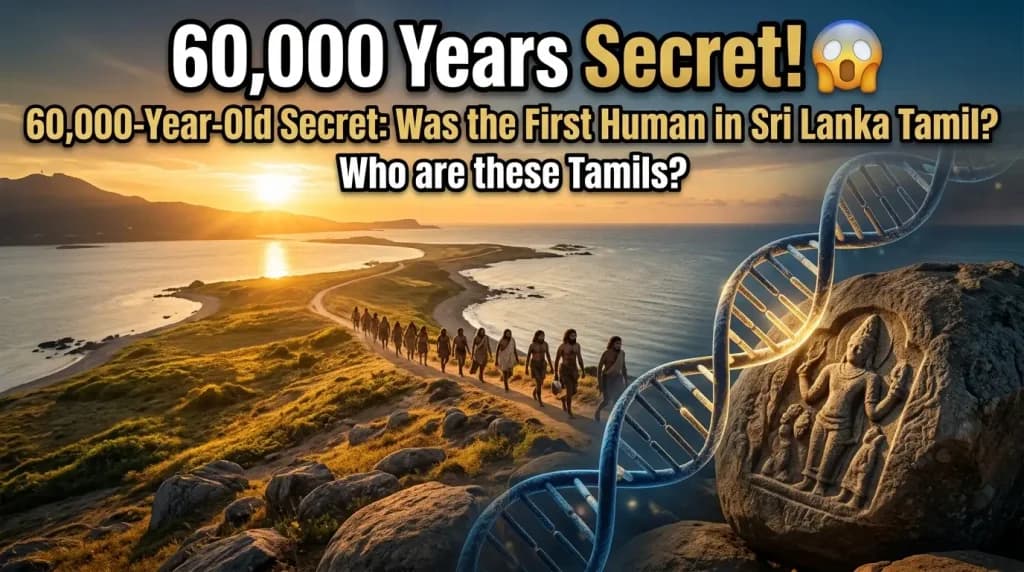
The 60,000-Year Human Journey
Modern science traces all humans alive today back to Africa, roughly 60,000 years ago. From there, early humans migrated across the Red Sea, along the Arabian coast, and eventually reached the Indian subcontinent.
Here’s the twist: the narrow sea between India and Sri Lanka, the Palk Strait was land until about 7,000 years ago. Tamils could have walked from one region to the other.
This changes everything.
It means the earliest Tamil populations in South India and Sri Lanka weren’t isolated. They shared movement, survival strategies, and even early cultural patterns. Sri Lanka wasn’t suddenly “settled” by newcomers; it was home to humans, Tamils included since prehistoric times, deeply tied to the surrounding region.

The Iron Age: A Turning Point in Tamil Civilization
For thousands of years, humans survived using stone and bone tools. Then, iron came along. Around 1000 BCE, the Iron Age spread across South India and into Sri Lanka.
Suddenly, Tamils were no longer just hunters. They became:
- Skilled farmers
- Forest clearers with iron tools
- Builders of rudimentary irrigation systems
This era is often called the Megalithic Culture, named for their burial practices. Large stones marked graves, and the dead were buried with tools, ornaments, and pottery.
Interestingly, these practices appear almost identically in both South India and Sri Lanka pointing to a shared Tamil cultural system across the region.

Pomparippu: A Forgotten Tamil Settlement
On Sri Lanka’s northwest coast lies Pomparippu, a site revealing burial remains of 8,000–12,000 individuals.
Pause. Think about that.
That’s not a tiny hamlet, it’s evidence of a thriving, organized Tamil settlement. Nearby areas like Mannar (Mathoddam) show human habitation dating back 4,000 years.
Burials included:
- Bodies placed in large urns
- Iron tools
- Beads and pottery
These methods closely resemble Adichanallur in South India, reinforcing deep Tamil cultural links across the region. Geography changed, but culture Tamil culture remained connected.

“Ko Veta”: Glimpses of Early Tamil Leadership
Archaeologists at Kandarodai and Anaikoddai in northern Sri Lanka uncovered a seal inscribed in early Tamil-Brahmi script with the words “Ko Veta.”
“Ko” can be interpreted as king or leader. This suggests structured leadership, local chieftains existed in Sri Lanka before 300 BCE, even before the rise of kingdoms like Anuradhapura.
Another inscription from Ampara contains “Dameda,” believed to mean “Tamil,” showing identifiable Tamil communities existed here in ancient times.
This is crucial: early Tamil societies were organized, governed, and culturally coherent not primitive or scattered groups.

Why Isn’t This Widely Known?
Archaeological evidence is strong, yet many Tamils don’t learn this in school. Historical narratives focus mainly on texts like the Mahavamsa, emphasizing Buddhist history and royal lineages.
Archaeology, however, tells a broader story one that predates these writings.
For example, rulers like Mutasiva of Anuradhapura bear names linked to “Siva,” indicating that religious traditions such as Saivism existed before Buddhism became dominant.
Historians like Professor K. Indrapala argue that early periods had fluid ethnic divisions, and over time, language and religion gradually shaped Tamil identities.
From Settlements to Tamil Kingdoms
From early settlements to flourishing kingdoms, Tamils in Sri Lanka developed complex social, cultural, and political systems. They weren’t just surviving, they were building civilizations, creating irrigation, crafting tools, and leaving cultural imprints that remain visible even today.
Their journey is long, intertwined with South India, and deeply rooted in the very soil of Sri Lanka, a legacy that deserves to be remembered.