Histroy / Apr 4, 2026
Hidden Roots of Sri Lanka : The Fascinating Mystery of Sri Lanka’s Ancient "Naga" Kingdom
Let’s Talk About the Nagas… Because History is Messy.
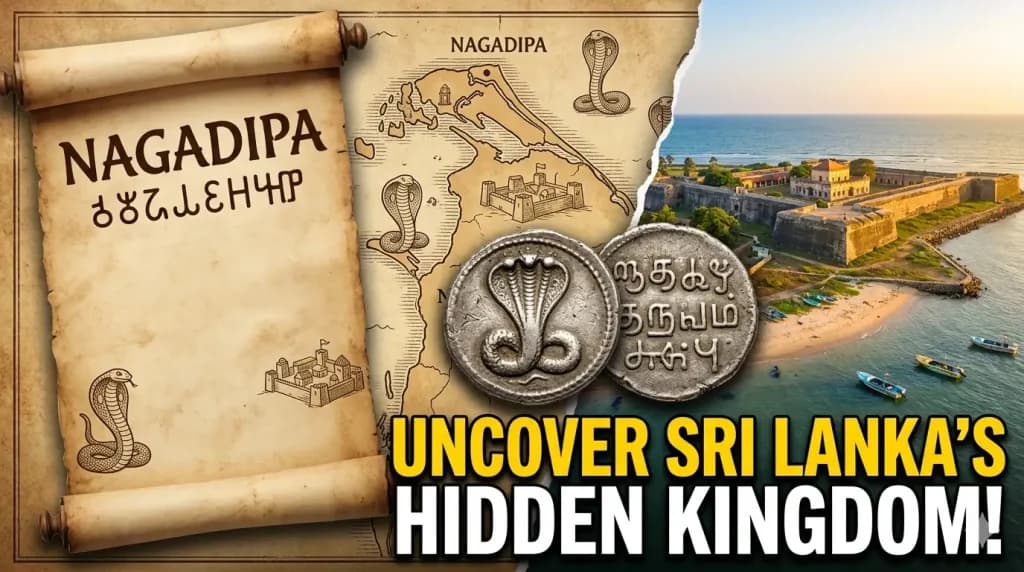
Honestly, looking at old maps of Sri Lanka makes you realize how much we just don’t know. Like, way back, Greco-Roman explorers—even Ptolemy himself on that famous world map of his, labeled the northern chunk of the island as “Nagadiba.” And the Mahavamsa (you know, that massive Pali chronicle) talks about a Naga king named Deeparaja ruling around the 5th century.
So these Naga folks were clearly a big deal up north. But then? Poof. After the 9th century, the word “Naga” basically falls off a cliff in the records, and suddenly everyone is just called “Tamil.”
Did an entire civilization just vanish into thin air? Or did they just… rebrand?
The Big Shift: Morphing into Tamils
I’ve always leaned toward Professor K. Indrapala’s take on this. He basically argued that the Nagas didn’t get wiped out or anything dramatic like that. They were likely just a sub-group under the massive umbrella of the Dravidian language and ethnic family.
Think about it. You’re living in the north, doing heavy maritime trade and constantly rubbing shoulders with folks from South India. Over a few centuries, you start absorbing the language, the customs, and the culture. Eventually, you just start calling yourself Tamil.
And if you need proof that isn’t just pure speculation, look at the Anaikoddai seal found in the Jaffna peninsula. It’s this cool little ancient metal seal that literally has both old Naga symbols and early Tamil-Brahmi script on it. It’s like a physical bridge between the two eras.

That “Dark Age” Label is Pure Laziness
Speaking of the Mahavamsa, traditional historians love to call the period between 300 and 900 AD the “Dark Age.” Why? Simply because the chronicle barely mentions it! But let’s be real here: just because someone didn’t write it down in a specific book doesn’t mean nothing was happening.
While the central kingdom in Anuradhapura was doing its thing, the Northern and Eastern provinces often called “Uttara Desa” were quietly building a massive society. Because they were so close to South India, they were the ultimate landing pad for merchants and travelers. Local “Vanni” chieftains ran the show up there pretty independently. Fun fact: whenever things got too chaotic or dangerous down south, deposed royals would actually flee up north for sanctuary!
A Wild Swing in Religion: From Buddha to Shiva
Here is a wild bit of history a lot of people overlook. Between the 300s and 600s AD, Buddhism was actually huge among the Tamil populations in the north and east! They didn’t just practice it; they loved the art. We’ve dug up Buddha statues at places like Kantarodai in the Jaffna peninsula made in that gorgeous Amaravati style from Andhra Pradesh.
But then the 6th century hit, and the “Bhakti Movement” exploded over in Tamil Nadu. Led by these passionate Saivite saints called Nayanmars, this massive wave of devotional Shaivism swept across the water. Suddenly, sacred hymns (Tevaram) were being sung for ancient Sri Lankan Shiva temples like Koneswaram and Thiruketheeswaram. Buddhism faded out, and Saivism became the absolute bedrock of Eelam Tamil identity.
Money, Monsoons, and the East Coast
History isn’t just wars and gods, though. It’s also about cold hard cash and engineering.
During this era, a massive Tamil merchant guild called the “Nanku Nattar” (literally, “The Four Countries”) held a ton of economic power. They operated right out of Anuradhapura, funded temples, and heavily backed irrigation projects.
And speaking of irrigation, the massive ancient tanks like Kanthalai and Minneriya were huge collaborative efforts. It wasn’t a one-way street either. Old Sangam literature mentions that the Chola King Karikalan actually used expertise and labor from Sri Lanka to build dams across the Kaveri River in India. Talk about early tech sharing! We even found an 8th-century inscription from this Nanku Nattar guild right near the royal palace in Anuradhapura, written in a mix of Tamil and Pallava Grantha. The fact that a Tamil guild could put up a monument that close to the Sinhalese royal palace shows you exactly how much pull they had.
Down on the east coast, around Batticaloa, things were just as vibrant. They operated as independent chieftaincies, playing a complex game of chess, allying with the south or the north depending on which way the political wind was blowing.

So, by the 9th century, you have this incredibly stable, localized society with deep roots. But all of that was about to get flipped on its head. The massive naval empire of the Cholas was eyeing the horizon, and Raja Raja Chola was about to change the game entirely. But… that’s a whole other story for another day.