Jaffna / Mar 28, 2026
The Sinking "Sand Jungle" of the North: – A Guide to the Manalkaadu Dutch Church Ruins
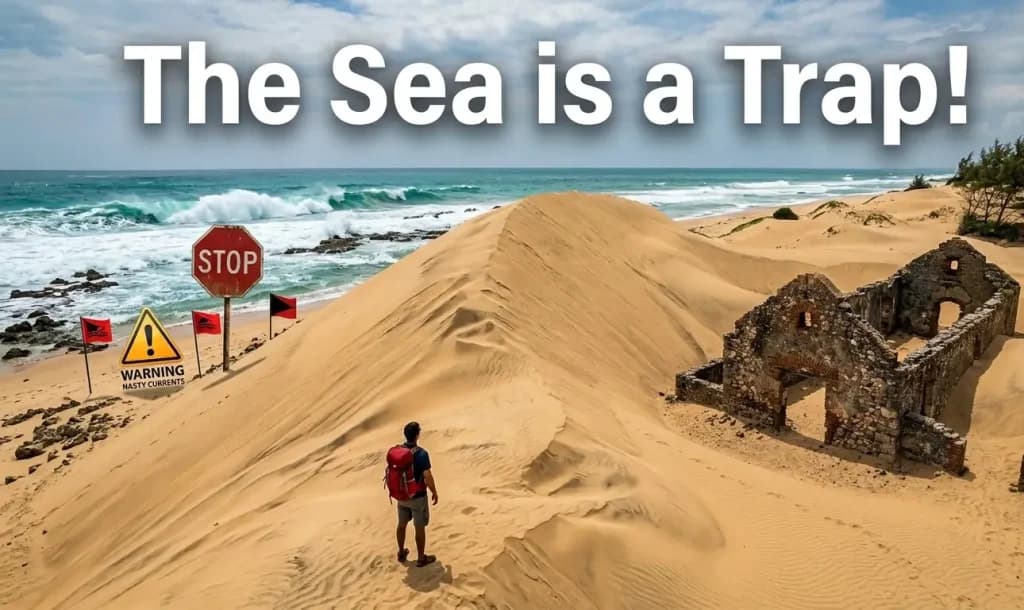
The wind up in Manalkadu doesn’t just blow; it carves. If you’re trekking out to the northeastern tip of the Jaffna Peninsula, past the salt-sprayed palms of Point Pedro, you’ll find something that feels less like a tourist stop and more like a glitch in the timeline. They call it the “Sinking” Dutch Church, though “Manalkaadu Dutch Fort” is the name that usually sticks to the maps.
Honestly? It’s a bit of a ghost story written in coral stone and brick.

The “Is It or Isn’t It?” History.
Here’s the thing—history here is as shifty as the dunes themselves. While the official Gazette No. 1,739 (dating back to late 2011) legally stamps this place as a “Protected Monument” under the name “Manalkaadu Dutch Chruch,” the actual origin story is a mess of “maybe.”
The Dutch Claim: Some say the VOC (Dutch East India Company) put this up in the 17th century—partly as a triangular fort to eyeball the British during the 1660s, and partly as a chapel.
The British Twist: Other accounts shrug and say it’s actually a late 19th-century British build.
Whatever the truth is, the architecture is wild. We’re talking rare coral stone and lime mortar made from scorched shells. It’s the kind of rugged masonry that was built to survive monsoons but is currently losing a slow-motion wrestling match with the sand.
What’s Actually There?
Don’t expect a gift shop or a ticket booth. You’re basically walking into a “Sand Jungle” (which is what Manal Kadu translates to in Tamil).
The Ruins: Roofless walls and arched entrances that look like the ribs of some buried giant.
The Dunes: These are supposedly the longest in Sri Lanka, some hitting 16 meters high. They move. Seriously. Back in the ’50s, they literally ate an entire village.
The Graveyard: Near the ruins, you’ll see crosses half-hidden in the sand—some marking old graves, others memorializing those lost in the 2004 tsunami. It’s heavy, beautiful, and incredibly quiet.

The “No-Nonsense” Logistics
If you’re going to do this, don’t be “that” traveler who shows up unprepared.
The Drive: It’s about 33km from Jaffna—roughly 45 minutes if the traffic behaves. From Point Pedro, it’s a 12km skip down the coast.
Facilities: Zero. Zip. Nada. Bring your own water and snacks, and for the love of everything, take your trash back with you.
Safety: The ocean here looks tempting, but the currents are nasty and the floor is jagged coral. Maybe just stick to wading.
The Vibe
You’ll see casuarina trees flickering in the heat and local fishermen who are usually happy to chat if you aren’t being weird about it. It’s a “working” village, not a museum.
If you’ve got a full day, swing by the Point Pedro Lighthouse (no photos allowed there, sadly) or the Vallipuram Vishnu Temple nearby. But Manalkadu is the highlight. It’s a place that feels like it’s being held in a grainy, sandy palm, waiting for the wind to decide what happens next.