
Mannar / Aug 27, 2025
Kunjukulam Hanging Bridge Madu – Hidden Suspension Bridge in Sri Lanka
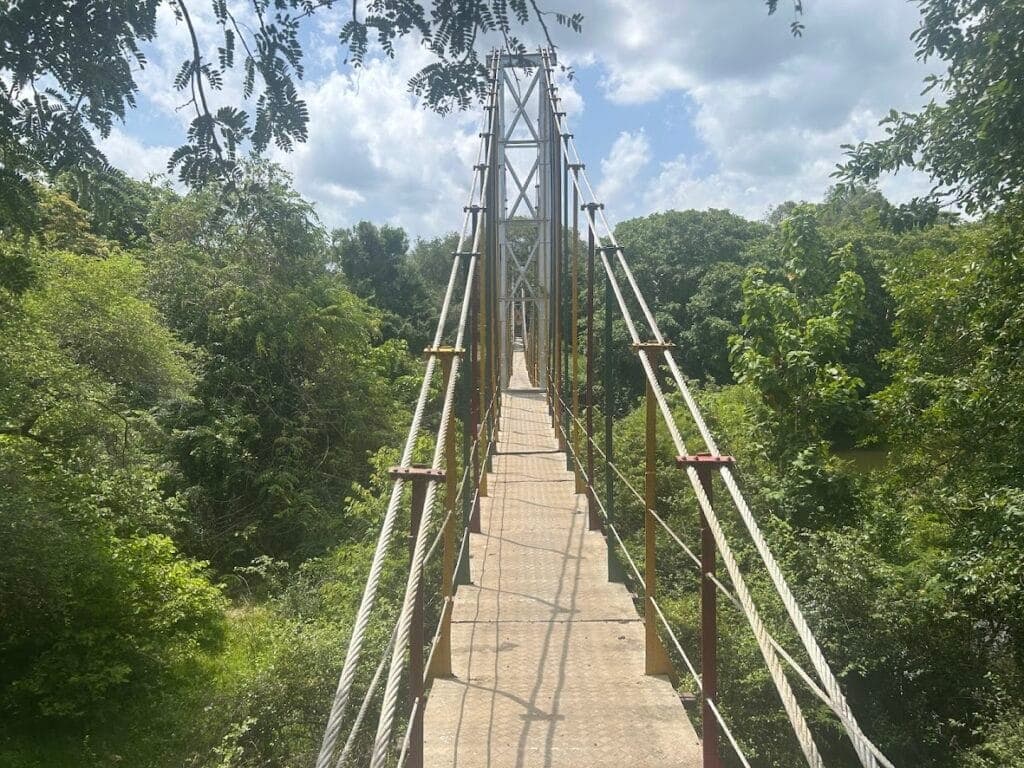
When people recall Madu, the main thing that will come to their mind is the Church of Madu which is also a pilgrimage site. However, nearby just a stone-throw away, there is one more interesting sight-seeing destination, the Kunjukulam (Kunchikulama) Hanging Bridge, an ancient bridge that is hung between waters of the Malwathu Oya waters. It has nothing on the church, being less pretentious, and yet it possesses its own beauty, and a kind of homeliness about it, in relating the story of rural life, engineering skill, and the quiet picturesqueness of countryside. The adventurous voyager will venture to take it as a side journey.

Finding the Bridge
It is possible to reach the bridge via a small road going to the left around 1.5 km when the turn-off to Madu Church is reached when coming in by Medawachchiya. The entrance to the area is marked with a small sign which indicates visitors the way to go to the site On your way up this road you will come across snatches of history.
After about 800 meters, you will come upon the fragments of an ancient steel arch bridge that cross the Yoda Ela canal. Yoda Ela itself is a wonder, a 13 km long man-made canal by king Dhatusena (459 477 AD) to draw water to Malwathu Oya to the big reservoir Yoda Wewa. There is also a newer six-bay concrete bridge just north of the old five-arc granite flow-control bridge. Cumulatively, these structures bring about a stratified image of the long history Sri Lanka has with irrigation and water management systems. Cross a small Sapaththu Palama (a low-level ford), and move about 600 meters and the destination in front of your eyes will be the Hanging Bridge of Kunjukulam.

A Bridge With Character
Exceeding more than 100-meters long, the hanging bridge is held up by two tight steel cables across Malwathu Oya. It has a floor composed of steel sheets resting on shorter wooden joists spaced widely apart — but most of these joists have rotted now, making the floor uneven in some spots. Crossing is at your risk and should be done slowly by taking care of every step that you make as you cross.
Suspension bridges of this type are locally know as Sangili Palama or Ellena Palama or chain bridges or hanging bridges in Sinhala. Thongu Paalam in Tamil, These bridges played key connective roles in the countryside of Sri Lanka, particularly before the introduction of modern concrete bridges. The hanging bridge of Kunjukulam was once more than a point of crossing to villagers in earlier times as it was their connection to schools, markets and the adjacent communities. Now, however, it has been made unnecessary by a near-by concrete bridge. Nevertheless, in it, there is a silent reminder of the shifting times when such swinging wooden pathways were the lifelines.

The Experience of Crossing
Although its current state is in some quite severe wear, there is something appealing about walking across this old suspension bridge. The calm rocking under your feet, the soft sound of water in motion, and the wide river line made out of greenery will allow you to take a second and experience a feeling of serenity. The bridge and the area around it provides photographers with ample sources of inspiration; rustic textures, a wide view of the waters, and the feeling of solitude that can hardly be equaled in such popular attractions. It is best in the early morning and the late afternoon, when the light is soft gold.
The charm in travelling to see the Kunjukulam Hanging Bridge is not just the bridge but the trip into the bridge. In between there are irrigation marvels that are more than 1,500 years old, people harking back at how they used to live on canals and rivers, and how state of the art infrastructure fitted in with the ancient one. It is not a touristic attraction fixed-up how it should be There are no ticket booths, souvenir shops or crowds. Rather, there will be silence, history and the rustic beauty of rural Sri Lanka.
Best Time To Go: Morning or late in the afternoon. Here, the light is really beautiful, and the heat is tolerable.
How to reach there: Watch out on the turn off 1.5 + KM before Madu Church (coming out of Medawachchiya). The road is narrow but is sign posted.
Safety: Only go across when you are sure and do not go across after heavy rains.
Surroundings: Great places nearby include the Madu Church itself, Yoda Ela canal, the Yoda Wewa reservoir and the granite and steel bridges in the proximity.

Why It is Worth Visiting
Although the Kunjukulam Hanging Bridge might not have been used as it was originally fashioned, it is an evocative piece of living history. When you are standing on it, one can almost envision the generations of people who over the centuries would cross it on a daily basis carrying harvests or leading cows and sheep or just on their way to school. Our modern day world is full of stories and legends, here is another one to add to the list – in this part of the world where every river and every canal has centuries of history attached to it, here is another bridge showing the inseparability between people and water in our country. It is a low key getaway that is worth the detour, especially to travelers who desire to get more than what the usual stops have to offer.